
Photoluminescence and Light Emitting Metasurfaces
Let there be light !
Controlling spontaneous emission photon by photon, emitter by emitter
The spontaneous emission of light by an emitter is not an intrinsic process. On the one hand, it depends on the electromagnetic environment. On the other hand, it depends on the presence of other emitters with which it can interact and exchange energy. Engineering these interactions between the emitter and the resonator makes it possible to design new light sources that differ significantly from commonly encountered light sources.
In fact, “traditional” light-emitting systems are based on the combination of a material that serves as the actual light source, along with a set of optical components used to filter its spectrum, impose a polarization state, or control the angular distribution of the emission through an optical system. These sources therefore combine several potentially bulky components and are also energy-inefficient: the properties of the emitted light are primarily shaped through filtering (spectral, spatial, polarization, etc.), meaning that all energy from the initial source that does not correspond to the intended use of the source is rejected and lost.
In our projects, we are studying new concepts for light sources called “light-emitting metasurfaces.” These are ultra-thin components comprising nanostructures coated with photoluminescent emitters.
These components differ from conventional diffractive metasurfaces: the latter are based on the scattering of a coherent incident wave—external to the system—by independent resonators. An emitting metasurface incorporates within itself both the light source—the numerous emitters—and the mechanism for shaping the emission—the nanostructures, designed to exhibit extended collective modes, which restore the spatial coherence of the emission over long distances across the sample’s surface.
Light-emitting metasurfaces thus make it possible, within an ultrathin system, to channel light emission into desired radiation modes, all using ultrathin nanostructured components.
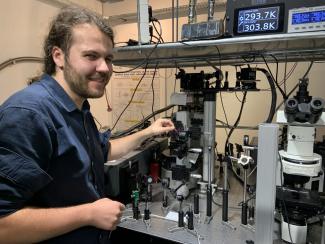
| Simon Landrieux PhD Student 2027 simon.landrieux@institutoptique.fr Office R2.52 / Phone +33 (0)1 64 53 33 66 |

| Tenzin Montlouis-Félicité PhD Student 2028 tenzin.mointlouis-felicite@institutoptique.fr Téléphone / Bureau : +1 33 64 53 33 65 / R2.52 |
ALUMNI | |
 | Aurélian Loirette--Pelous PhD Student 2023 Aurelian defended his PhD thesis on June 5th 2023. |

| Elise Bailly PhD Student 2023 Elise defended her thesis on May 30th 2023 |

| Dr. Hector Monin PhD 2020 Hector defended his thesis on November 9th 2020. His thesis title "Control of light emission by a thermalized assembly of emitters coupled to a resonator" |

| Dr. Ilan Shlesinger PhD 2019 Ilan defended his thesis in 2019 and joined AMOLF for a post-doc in the Netherlands His thesis title "Combining collective effects and resonators to control spontaneous emission." |
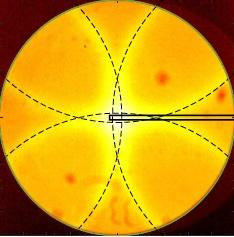
| Authors : Elise Bailly, Jean-Paul Hugonin, Jean-René Coudevylle, Corentin Dabard, Sandrine Ithurria, Benjamin Vest, and Jean-Jacques Greffet |
 | General relation between spatial coherence and absorptionThe authors : DOI : 10.1364/OE.405484 Opt. Expr. 29(1) (2021) |
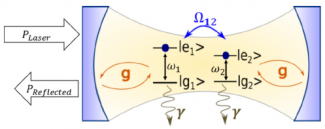
| Tunable bandwidth and nonlinearities in an atom-photon interface with subradiant statesThe authors : DOI : 10.1103/PhysRevA.98.013813 Phys. Rev. A 98, 013813 (2019) |
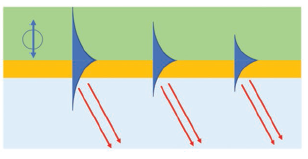
| Light Emission by a Thermalized Ensemble of Emitters Coupled to a Resonant Structure Les auteurs : Léo Wojszvzyk, Hector Monin, Jean-Jacques Greffet DOI : 10.1002/adom.201801697 Adv. Optical Mater. 2019, 1801697 |