
Quantum engineering - single photon emission
Controlling Light Emission, Photon by Photon
Quantum Nanophotonics in Action: Strong Coupling, Superradiant States, Color Centers, and 2D Materials
The development of quantum technologies is spreading across numerous rapidly growing fields of application: communications and cryptography, quantum computing, simulators, sensors, and more. Many of these advances rely on the development of new sources of single photons, in order to identify sources with suitable photophysical properties and to keep pace with the evolution of the technologies being developed. The team is exploring the potential of quantum nanophotonics to control, both temporally and spatially, the emission of single photons from various emitters using nanostructures, resonators, antennas, or through collective effects involving other emitters.
We are studying the emission of single photons by colored centers in hexagonal boron nitride (hBN), a two-dimensional material (similar to graphene, for example), which contains colored centers that emit single photons (similar to the NV centers in diamond). The colored centers in hBN have the advantage of behaving as very good sources of single photons (stable and bright) even at room temperature. Furthermore, the material’s 2D nature makes it possible to integrate it into structures that take advantage of its flatness to better control the emitters’ properties (by precisely locating and positioning them near antennas, for example). The team has therefore recently launched a research initiative focused on the localization, transfer, and positioning of these single-photon emitters in nanophotonic environments, in parallel with the design of nanostructures whose functionalities address the flow of single photons—enabling, for example, the collection of the entire flux emitted by these sources.
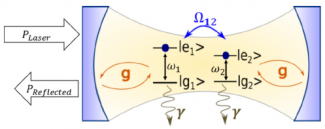
Previous theoretical work by the team has also made it possible to study the consequences of dipole-dipole coupling between two identical, closely spaced emitters that are otherwise mutually tunable in energy. The coupling of two two-level systems gives rise to new hybrid quantum states—known as super-radiant or sub-radiant states—whose lifetimes are altered. We have shown that by adjusting the coupling and the relative detuning between the two emitters in real time, the spontaneous emission lifetime can be precisely controlled, thereby shaping the wave packet of the emitted single photon over time. We are investigating the experimental feasibility of achieving such coupling in solid-state systems, particularly using hBN color centers.
We are also studying theoretically the collective properties that arise when a large number of cold atoms (on the order of 100) are trapped in free space within a lattice whose lattice spacing is smaller than the wavelength associated with the atomic transition. In such a system, there are a very large number of modes that can be extremely subradiant or superradiant. By locally manipulating the transition frequencies of the atoms that make up the chain, we have proposed a new protocol for controlling a single photon, in which the photon is absorbed in its most super-radiant state and then transferred to its most sub-radiant state, where it can be stored and studied for a very long time. Finally, upon request, we can re-emit the photon in the desired direction.
| Maxime Barreau PhD student (PhD 2027) maxime.barreau@institutoptique.fr Phone / Office : +1 33 64 53 33 66 / R2.52 |
| Vanessa Yahiaoui Engineering Apprentice vanessa.yahiaoui@institutoptique.fr Phone / Office : +1 33 64 53 33 66 / R2.52 |

| Dr. Benjamin Vest Maître de Conférences en Optique et Photonique benjamin.vest@institutoptique.fr Téléphone / Bureau : +1 33 64 53 32 74 / R2.54 |
Alumni | |
Dr. Nikos Fayard Post-doc, now assistant prof. at ENS/Lumin | |

| Dr. Ilan Shlesinger defended his thesis in 2019, now CNRS Researcher at lab MPQ (U Paris-Cité) His PhD dissertation: "Contrôle de l'émission spontanée de lumière par effets collectifs en présence d'un résonateur." |
 | Lifetime-Limited and Tunable Quantum Light Emission in h-BN via Electric Field ModulationThe authors : DOI : https://doi.org/10.1021/acs.nanolett.2c02163Nano Lett. 2022, 22, 19, 7798–7803 |
| Temperature-dependent Spectral Emission of Hexagonal Boron Nitride Quantum Emitters on Conductive and Dielectric SubstratesThe authors : DOI : https://doi.org/10.1103/PhysRevApplied.15.014036 Phys. Rev. Applied 15, 014036 |
Time-frequency encoded single-photon generation and broadband single-photon storage with a tunable subradiant stateLes auteurs : DOI : https://doi.org/10.1364/OPTICA.396223 Optica Vol. 8,Issue 1, pp. 95-105 (2021) | |
| Tunable bandwidth and nonlinearities in an atom-photon interface with subradiant statesLes auteurs : DOI : 10.1103/PhysRevA.98.013813 Phys. Rev. A 98, 013813 (2018) |