Pasar al contenido principal Aller au menu Aller à la recherche

EXOSHARE

EXOSHARE

Enhancing European exoplanet science with high angular resolution astronomy on shared observing facilities


This project, with 25 partners gathering 29 research units and institutions, 1 industry, ESO and GTC for research infrastructures and facilities (see List of participants), has been resubmitted in 2025 to the call HORIZON-INFRA-2025-01-TECH-02. The information below corresponds to the two first pages of the proposal.


Introduction to objectives and ambition

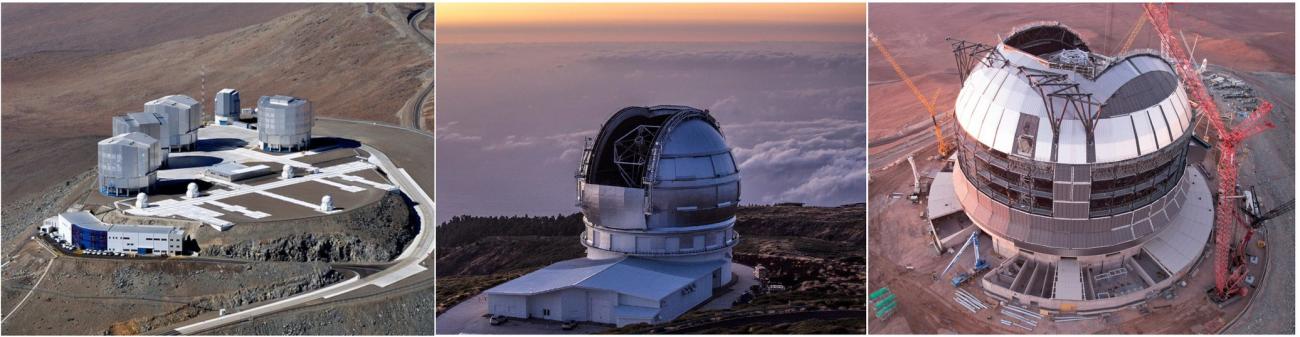
Elligibility condition: our project targets four large European research infrastructures (RIs): the Gran Telescopio Canarias (GTC), currently the largest (10.4-meter) single-aperture telescope in operation in the world, located in the Canary Islands; the Very Large Telescope (VLT), a unique infrastructure featuring four 8-meter unit telescopes (UTs) that host many of Europe's most prolific optical instruments to date; the VLT-Interferometer (VLTI) which combines the light from up to four UTs or 1.8-meter Auxiliary Telescopes (ATs) giving access to baselines up to 200 meters; and the upcoming Extremely Large Telescope (ELT), the 39-meter behemoth that will be the largest optical telescope in the world for the decades to come. Of these RIs, the ELT is identified since 2016 as an ESFRI Landmark infrastructure. Our project includes as a partner, the European Southern Observatory (ESO) – an international European research organization and EIROforum member that not only currently leads the development of the ELT but also operates the VLT and the VLTI.

VLT-VLTI, GTC and ELTtelescopes

Figure 1: The four world-class European research infrastructures that will benefit from the R&D activities conducted over the course of the EXOSHARE project. Left: the Paranal platform hosting the four VLT UTs and the underground infrastructure enabling the VLTI. Middle: the GTC, currently the largest optical telescope in operation in the world. Right: the ELT, currently under construction.

Sustain scientific European leadership: In the Fall of 2022, our community celebrated the 60th anniversary of the funding of ESO, today supported by 16 Member States in Europe, along with Chile (its Host and Partner State) and Australia (Strategic Partner). With world class observing infrastructures like the VLT and the VLTI, operational since the early 2000, ESO serves as the central hub of European optical astrophysics and has enabled Europe to become a scientific powerhouse. Europe is on its way to become the undisputed world leader of optical astrophysics for the decades to come, with the arrival of the ELT, whose first light is expected as early as 2029.

Instrumentation for astrophysics does not exist off-the-shelf, and competitive international consortia of scientists across Europe have completed these infrastructures with successive generations of custom high-performance instruments. To ensure that new iterations remain competitive requires the continuous support of a continuum of activities ranging from the early R&D of technological components in collaboration with industrial partners to the on-sky validation of advanced prototypes, motivating this EXOSHARE submission in response to the INFRA-TECH call for proposal. Our project ties together activities that directly address the recommendations of the European community built Astronet roadmap, and that are motivated by the urging science case of exoplanets and potential life elsewhere in the Universe.

The Astronet Science Vision & Infrastructure Roadmap 2022-2035 (A Strategic Plan for European Astronomy) identified the following questions: "What are the necessary conditions for life to emerge and thrive? Are we alone?" and "How do planets and planetary systems form and evolve?" as two of the most pressing fundamental questions about our Universe. Table 1 summarizes the insights of the roadmap and draws a very clear picture of the steps required to answer these questions. Our EXOSHARE proposal will provide the community with the means to tackle these challenges.

Target RI Methodological Recommendation Technological Recommendation
VLT The development of high-contrast, high-angular resolution observations as means to enable exoplanetary systems observations. The Planetary Camera and Spectrograph (PCS)
for the ELT will be dedicated to detecting and characterizing nearby Neptune- and Earth- sized exoplanets. Achieving such a spectacular ambition requires a combination of eXtreme Adaptive Optics (XAO), coronagraphy and spectroscopy, all of which require technologies that can benefit from the strong heritage of today’s instruments (e.g., SPHERE), but need to be pushed much beyond current capabilities.
ELT The continued development of direct-imaging and spectroscopic characterization of exoplanets and their atmosphere will require the direct-imaging capabilities of ELT/PCS.
VLTI The VLT and the VLTI will remain the workhorse of European ground-based optical astronomy, even in the era of ELT and should therefore continue being supported and new instruments developed. The VLTI has become a very powerful facility
for milli-arcsec studies of AGNs, exoplanets and
young disks, evolved stars. Future studies for optical/infrared interferometry include new potential arrays up to kilometric baselines, the development of new technologies such as heterodyne receivers, fibered beam transport and delay compensation, compact and fibered off-axis telescopes.
Table 1: Summary of the methodological and technological recommendations of the Astronet 2022-2035 roadmap as requirements to address two of the the fundamental questions regarding the formation and evolution of planetary systems and the emergence of life in the Universe, and their consequences on ESO’s optical/IR observing facilities.

EXOSHARE brings together academics and industrials to support the technological and methodological developments that will lead the European community toward 2035 and beyond, ensuring that its hard-built world-class observing facilities: the VLT, the GTC, the ELT and the VLTI (ordered with increasing angular resolution potential) keep producing the highest possible impact observations of exoplanetary systems and unlock the secrets of their atmospheric composition.


List of participants


Participant #

Participant organization name

Country

 1

Le Centre National de la Recherche Scientifique – CNRS

FR

2

Observatoire de la Côte d’Azur – OCA (affiliated partner)

FR

3

Université Grenoble Alpes – UGA (affiliated partner)

FR

4

Institut d’Optique Théorique et Appliquée – IOTA

FR

5

Observatoire de Paris – OBSPARIS

FR

6

Office National d'Études de Recherches Aérospatiales – ONERA

FR

7

Bertin ALPAO – ALPAO

FR

8

European Southern Observatory – ESO

IO

9

Max Planck Institute For Astronomy – MPIA

DE

10

Universitat Zu Koln – UZK

DE

11

Université de Liège – ULIEGE

BE

12

Katholieke Universiteit Leuven – KULEUVEN

BE

13

University of Durham – UDUR

UK

14

University of Exeter - UNEXE

UK

15

Heriot-Watt University – HWU

UK

16

Stichting Netherlandse Wetenschappelijk Onderzoek Instituten – NWO-I

NL

17

Leiden University – ULEI

NL

18

Universidade Do Porto – UPORTO

PT

19

Istituto Nazionale di Astrofisica – INAF

IT

20

Université de Genève – UNIGE

CH

21

Université de Berne – UBERN

CH

22

Universität Wien – UNIVIE

AT

23

Instituto de Astrofísica de Canarias – IAC

ES

24

Gran Telescopio Canarias – GRANTECAN

ES

25

Uppsala Universitet – UU

SE


Site réalisé par Intuitiv Intecartive